
Why does a tooth hurt after a filling?
Mild sensitivity after a filling is often temporary, but pain when biting, lingering temperature sensitivity or throbbing may require a dental review.
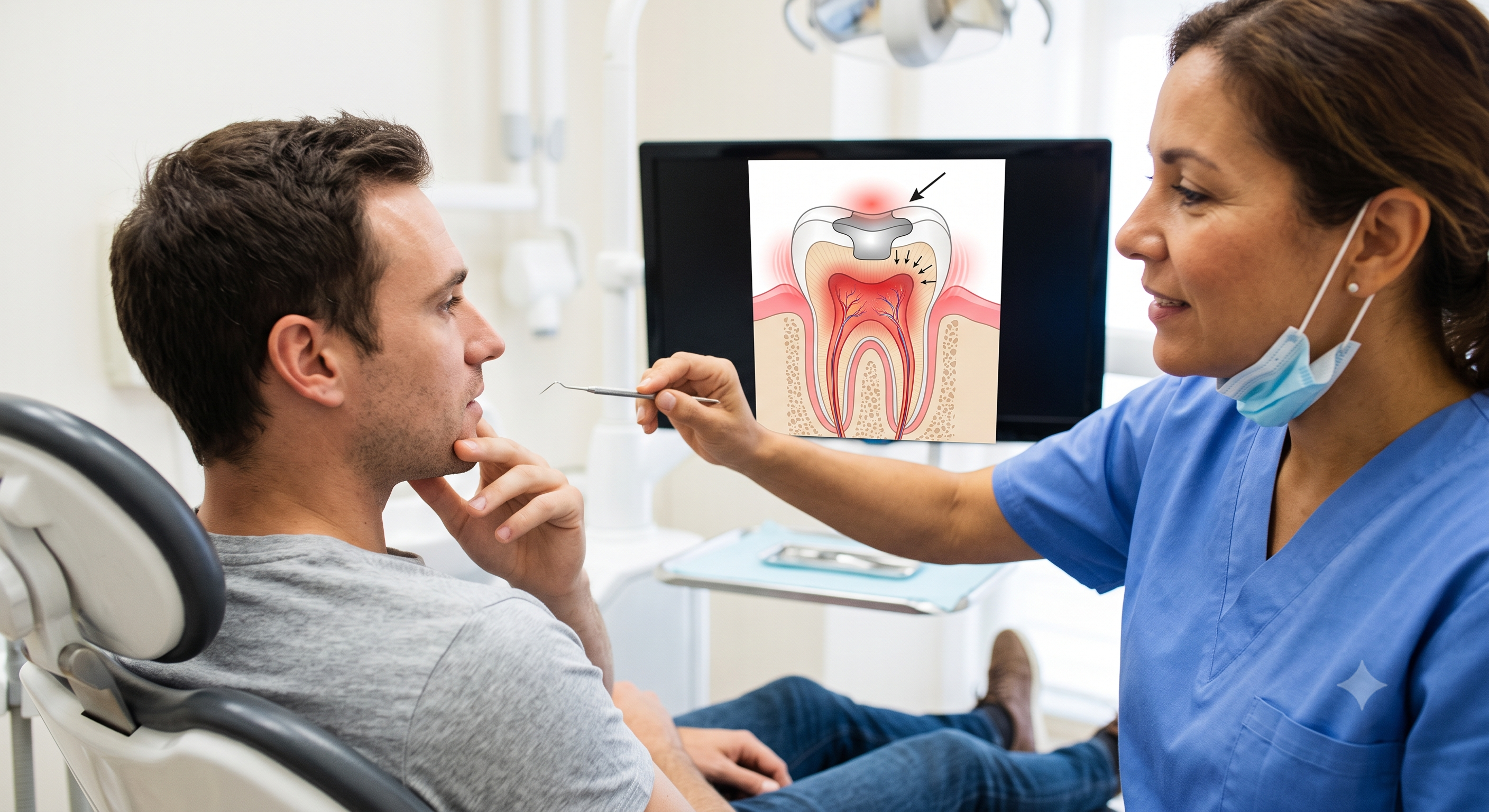
A tooth may hurt after a filling because of temporary post-treatment sensitivity, a filling that is too high, irritation of the dental pulp after deep decay, a crack, or an imperfect filling margin. Mild sensitivity that steadily improves is often temporary; severe, throbbing, worsening or lingering hot-and-cold pain should be assessed by a dentist.
Why does a tooth hurt after a filling?
Pain after a filling is often caused by temporary sensitivity as the treated tooth settles after the procedure. Other possibilities include a filling that is slightly too high, deep decay that has irritated the dental pulp, a crack in the tooth or a problem at the edge of the restoration. Mild discomfort that improves each day can often be monitored. Pain that is severe, throbbing, waking you at night or lingering after hot or cold exposure should be assessed by a dentist.
Direct answer
A newly filled tooth can temporarily react to cold, heat, sweet foods or chewing pressure. This may be more noticeable after a deep filling. The main features of ordinary post-treatment sensitivity are that it is brief and gradually improves. Pain that stays the same, becomes stronger or starts spontaneously should not automatically be dismissed as the tooth “getting used to the filling.”
Common causes of pain after a filling
Temporary post-treatment sensitivity
Removing decay and preparing the cavity can mechanically and thermally stimulate the tooth. Even when the filling is correctly placed, the tooth may be more sensitive to cold, sweets or pressure for a short time. The gum may also feel sore because of the injection site, isolation devices or a matrix band used during treatment.
Temporary sensitivity usually lasts only briefly after a trigger, eases when the trigger is removed and becomes milder over time. Prolonged spontaneous throbbing is less typical.
A filling that is too high
If the new filling touches the opposing tooth before the rest of the teeth meet, chewing force can become concentrated on one spot. People often describe the tooth as feeling “too tall” or say it is the first tooth to touch when they close their mouth.
The discomfort is commonly noticed while chewing, clenching or biting something firm. A dentist can check the bite with marking paper and reshape the filling if needed. Leaving a clearly high filling unadjusted can keep the tissues around the tooth under excess pressure.
Deep decay and irritation of the pulp
When decay extends close to the nerve-containing pulp, the pulp may already be irritated before the filling is placed. A brief, sharp response to cold may fit with reversible irritation. By contrast, pain that is triggered by heat, continues after the stimulus has gone, starts on its own or wakes you at night needs closer investigation.
These symptoms do not establish a diagnosis by themselves. The dentist considers the history, temperature tests, bite tenderness, pulp vitality and X-ray findings together.
Leakage or bonding problems at the filling margin
Tooth-coloured composite fillings are bonded to the tooth. If moisture control was difficult or the restoration did not seal perfectly, the edge may become sensitive. Possible clues include sensitivity to cold or sweets, a rough margin or food repeatedly getting caught around the filling.
If a margin problem is suspected, repeatedly masking the pain with medication is not a substitute for checking the restoration.
A crack in the tooth
A small crack that existed before the filling, or one that becomes more noticeable under chewing forces, can cause sharp pain when biting something firm. In some cases the pain is felt when pressure is released. Cracks do not always appear clearly on an X-ray, so bite tests, magnification and a detailed clinical examination may be needed.
Gum or injection-site soreness
Not all discomfort comes from inside the tooth. Local anaesthetic injections, a matrix band or work close to the gumline can leave nearby tissues sore for a few days. This pain is often tender to touch and feels different from deep throbbing inside the tooth.
What can the pain pattern suggest?
The character of the pain cannot diagnose the cause, but it gives the dentist useful clues.
- Brief, sharp sensitivity to cold: May be temporary sensitivity or reversible pulp irritation.
- Pain that lingers after hot or cold exposure: May indicate more significant pulp involvement.
- Pain only when biting: May come from a high filling, a crack or tenderness in the tissues supporting the tooth.
- Spontaneous throbbing: Needs assessment for pulp inflammation.
- Pain that wakes you at night: Should not simply be watched for an extended period.
- Swelling, fever or a bad taste: Requires timely evaluation for possible infection.
The same symptom can have more than one cause, so an examination remains important.
What can you do at home?
Wait until numbness has fully worn off before chewing so that you do not accidentally bite your cheek, lip or tongue. If the tooth is sensitive, temporarily reducing very hot, very cold and very hard foods may make it more comfortable. Keep the area clean using a soft toothbrush and gentle pressure rather than avoiding it completely.
Pain medication is not suitable for everyone. Paracetamol or ibuprofen may help some people temporarily when used exactly as directed, but pregnancy, stomach ulcers, kidney disease, blood-thinning medication, allergies or drug interactions may change what is safe. A pharmacist or clinician can advise. Do not exceed the recommended dose, and do not place aspirin directly on the tooth or gum.
A toothpaste for sensitive teeth may reduce mild sensitivity for some people, but it will not correct a high filling, a crack or pulp disease.
When should you contact a dentist?
Arrange a review if:
- the pain lasts more than two days without clear improvement,
- biting causes a sharp, localised pain,
- the filling feels like the first point of contact,
- pain continues well after hot or cold exposure,
- pain starts without a trigger or wakes you at night,
- pain affects daily activities despite pain relief,
- the filling is loose, broken or missing,
- the gum, face or jaw is swollen,
- fever, discharge, a bad taste or general unwellness is present.
Rapidly spreading swelling, difficulty breathing, swallowing or speaking, or severe swelling involving the mouth or neck requires urgent assessment.
What may happen at the dental review?
The dentist will ask when the pain began, what triggers it and how long it lasts. They will then check the bite, restoration margins and surrounding gum. Depending on the findings, the assessment may include bite and percussion tests, cold or other pulp-vitality tests, flossing through the contact point, an X-ray and examination for cracks.
Treatment depends on the cause. A high filling may need only a small adjustment. A restoration with a defective margin may need repair or replacement. A mildly irritated pulp may be monitored. More advanced pulp damage may require root canal treatment. That decision is based on the complete clinical picture rather than on pain alone.
How is this assessed through Dentselfy?
A photo- or selfie-based initial review may help identify visible issues such as a broken filling, gum changes or obvious swelling. However, bite height, pulp vitality, fine cracks and problems around the tooth root cannot be diagnosed reliably from a photograph alone.
The appropriate process is to collect the details of the symptoms and arrange dentist-led assessment when needed. Bite analysis, vitality testing and imaging may then be used. The aim is not to guess the cause from an image, but to reduce uncertainty and direct the person to the right level of care.
Key points
Mild sensitivity that gradually settles is common after a filling. Biting pain may be related to a high filling. Lingering temperature pain, spontaneous throbbing, night pain or swelling needs attention. The pain pattern can guide the examination, but only a dentist can confirm the cause.
Frequently asked questions
Is cold sensitivity after a filling normal?
A brief response to cold that improves over time can be expected after some fillings. If pain continues after the cold is removed or becomes more intense, the tooth should be reviewed.
Will a high filling settle on its own?
A very small difference may become less noticeable, but a filling that clearly hits first and hurts during biting should not be expected to correct itself. A minor bite adjustment may be needed.
Why might root canal treatment be needed after a filling?
If decay was very deep, the pulp may already have been inflamed before treatment. Some teeth recover after the decay is removed and sealed, while in others the inflammation progresses. Root canal treatment is considered only after clinical tests and imaging.
Does a painful filling need to be removed immediately?
Not necessarily. If the only problem is a high bite, the entire filling may not need to be removed. A leaking margin, crack or pulp condition may require a different approach.
Can I eat after a filling?
It is safer to wait until numbness wears off to reduce the risk of biting soft tissues. If the tooth is tender, avoid chewing very hard foods on that side initially.
Is pain after a filling dangerous?
Most mild sensitivity is not dangerous. Increasing pain, swelling, fever, a bad taste, night pain or difficulty breathing or swallowing requires faster assessment.
Related questions
- How long should sensitivity last after a filling?
- How can I tell if a filling is too high?
- Is throbbing pain normal after a filling?
- When should hot-and-cold sensitivity improve?
- Why might root canal treatment be needed after a filling?
- When should I call a dentist about pain after a filling?
Medical information notice
This article provides general information only. The cause of pain after a filling varies from person to person, and online information or a photograph cannot replace a clinical examination. Seek prompt dental care for severe, worsening pain or pain associated with swelling.
Key takeaways
- Mild temperature sensitivity can occur for a few days and may sometimes take one or two weeks to settle.
- Pain focused on biting may occur when the filling contacts the opposing tooth too early.
- Pain that lingers after heat or cold can indicate that the dental pulp needs closer assessment.
- Swelling, fever, a bad taste, night pain or facial swelling should not be ignored.
- The cause can only be confirmed through a dental examination and, when needed, an X-ray.
Frequently asked questions
- Is pain after a filling normal?
- Mild, improving sensitivity, especially a brief response to cold, can occur after a filling. Pain that is getting stronger, starts without a trigger or disrupts daily life should be reviewed.
- How long can pain last after a filling?
- The duration depends on the depth of the filling and the condition of the tooth before treatment. Mild sensitivity may improve within days and can occasionally take one or two weeks. Pain that does not improve or becomes worse needs assessment.
- Why does the tooth hurt when I bite?
- The new filling may contact the opposing tooth before the rest of your bite. A dentist can check and adjust it. A crack or irritation around the pulp or supporting tissues can cause similar symptoms.
- Does throbbing mean I need a root canal?
- Not every episode of throbbing requires root canal treatment. However, spontaneous pain, night pain, pain worsened by heat or pain that lingers should prompt a pulp assessment.
- Can I take a pain reliever?
- If it is safe for you, an over-the-counter medicine such as paracetamol or ibuprofen may provide temporary relief when used according to the label or professional advice. It does not treat the cause.
- When is urgent care needed?
- Rapidly increasing swelling of the face, jaw, floor of the mouth or neck; difficulty breathing, swallowing or speaking; uncontrolled bleeding; or severe systemic illness requires urgent assessment.