
Does water cleaning (oral irrigator) replace dental floss?
An oral irrigator can support interdental cleaning by flushing food particles and soft debris, but it may not fully replace dental floss for everyone. The right choice depends on tooth spacing, gum health, braces, implants, bridges, and personal dexterity.
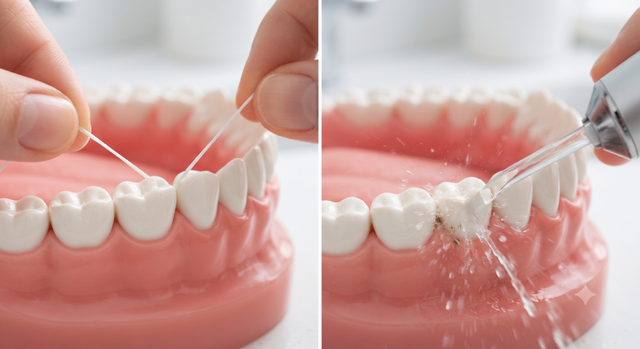
An oral irrigator can help remove food particles and reduce soft buildup near the gumline, but it does not always fully replace dental floss. Traditional floss provides direct contact with tight tooth surfaces, which may still be needed for effective plaque control.
Does water cleaning (oral irrigator) replace dental floss?
Water cleaning, often called an oral irrigator, water flosser, or dental water jet, can help flush food particles and soft debris from between teeth and around the gumline. However, it does not automatically replace traditional dental floss for everyone. Dental floss makes direct contact with the side surfaces of teeth, which is especially important in tight spaces. The best routine often depends on your tooth spacing, gum condition, restorations, braces, implants, and how consistently you can use each tool.
Direct answer
An oral irrigator can be an excellent support tool, but it is not a universal substitute for dental floss. In tight spaces, dental floss may still be needed because it slides between the teeth and wipes the tooth surfaces. In wider spaces, interdental brushes may be more effective. For braces, implants, bridges, crowns, sensitive gums, or limited hand dexterity, an oral irrigator can make daily cleaning easier and more comfortable.
The more useful question is not “Which product is always better?” but “Which method fits my mouth and my routine?”
What is an oral irrigator?
An oral irrigator is a device that directs a controlled stream of water between the teeth and along the gumline. It is designed to help remove food particles and soft debris from areas a toothbrush may not reach easily.
It can be especially practical around orthodontic brackets, fixed retainers, dental bridges, implant-supported restorations, back teeth, and areas where flossing is difficult. Many people also find it easier to use consistently than string floss.
Still, an oral irrigator does not remove hardened tartar. Tartar needs professional dental cleaning.
How is it different from dental floss?
Dental floss and oral irrigators both support interdental cleaning, but they work in different ways.
Dental floss works by physical contact. When used correctly, it gently wraps around the side of each tooth and wipes plaque from the surface. This can be especially useful where teeth touch tightly.
An oral irrigator works through water pressure. It can flush away loose particles, reach difficult areas, and support gumline cleaning. However, water flow may not always provide the same surface contact as floss.
For this reason, a water flosser should not simply be seen as a newer version of string floss. It is better understood as a different tool with different strengths.
When can an oral irrigator be especially helpful?
An oral irrigator may be useful when flossing is difficult or uncomfortable.
People with braces often struggle to guide traditional floss under wires and around brackets. A water flosser can help flush these areas and make daily cleaning easier.
People with implants, bridges, crowns, or fixed prosthetic work may also benefit from water cleaning as part of a dentist-recommended routine. However, the pressure setting and tip type matter, especially around implants or inflamed gums.
It can also be helpful for people with limited dexterity, arthritis-like hand difficulty, strong gag reflexes, or trouble reaching the back teeth.
When does dental floss still matter?
Dental floss can still be important when the spaces between teeth are very tight. In these areas, water may not pass through the contact point effectively enough to clean the tooth surface.
Floss is also useful when plaque is sticky and attached to the tooth surface. Water can help remove loose particles, but mechanical contact may be needed to disturb plaque.
If your gums bleed when flossing, that does not always mean you should stop immediately. Bleeding can happen because of aggressive technique, but it can also be a sign of gum inflammation. If bleeding continues, a dentist should evaluate the cause.
What about interdental brushes?
Interdental brushes are another important option. They are small brushes designed to clean between teeth when there is enough space.
They may be very effective for wider gaps, gum recession, bridge areas, implants, and periodontal maintenance. The size must be chosen carefully. Forcing a brush into a space that is too narrow can irritate the gum.
A dentist or hygienist can show which size fits each area safely.
Is using only a water flosser enough?
For some people, using an oral irrigator may be much better than doing no interdental cleaning at all. A routine that a person can actually maintain is valuable.
However, for many people, the best result comes from a combination. Someone with tight teeth may need floss plus a water flosser. Someone with wider spaces may need interdental brushes. Someone with braces may need an oral irrigator, orthodontic brush, and special floss threaders.
A single tool rarely fits every mouth.
How should an oral irrigator be used safely?
Start with a low or medium pressure setting, especially if your gums are sensitive. Aim the water stream gently along the gumline rather than forcing it into the gum tissue.
Use clean water unless your dentist recommends otherwise. Keep the water reservoir clean, avoid sharing tips, and replace attachments according to the manufacturer’s guidance.
If you have active gum disease, recent surgery, implants, orthodontic appliances, or unexplained bleeding, ask your dentist which pressure and tip are appropriate.
When should you see a dentist?
You should seek dental advice if bleeding continues, if your gums feel swollen or painful, if there is persistent bad breath between certain teeth, or if cleaning around an implant or bridge feels difficult.
A dentist can assess tooth spacing, gum levels, plaque retention areas, existing restorations, and your daily routine. This is the safest way to decide whether floss, interdental brushes, an oral irrigator, or a combination is best.
How Dentselfy approaches this question
At Dentselfy, oral hygiene questions are considered part of a personalized dental planning process. A photo-based initial review can help identify visible concerns such as gumline irritation, restorations, implants, or areas that may need closer evaluation. A final recommendation, however, requires dentist-led assessment.
The goal is not to recommend more products. The goal is to build a realistic, safe, and sustainable routine for your mouth.
Key points
- An oral irrigator can be helpful, but it does not fully replace floss for everyone.
- Dental floss provides direct surface contact in tight spaces.
- Interdental brushes may work better in wider spaces.
- Water flossers can be practical for braces, implants, bridges, and limited dexterity.
- Ongoing bleeding, swelling, or pain should be checked by a dentist.
Frequently asked questions
Is a water flosser better than dental floss?
Not for everyone. It may be easier and more comfortable for some people, but floss may still be more appropriate for tight spaces.
Can a water flosser prevent cavities?
It can support oral hygiene, but cavity prevention also depends on fluoride toothpaste, brushing technique, diet, interdental cleaning, saliva, and regular dental visits.
Can I use a water flosser if my gums bleed?
You may be able to use it gently on a low setting, but persistent bleeding should be evaluated. It may be a sign of gum inflammation.
Is an oral irrigator enough for dental implants?
Not always. Implant care may require specific brushes, floss, or water flosser tips. Your dentist should guide the routine.
Should people with braces use floss or a water flosser?
Often, both can be useful. A water flosser helps around brackets and wires, while orthodontic floss or interdental brushes may still be needed in certain spaces.
Can a water flosser remove tartar?
No. It can help with soft debris, but hardened tartar requires professional dental cleaning.
Related questions
- How do you use dental floss correctly?
- Dental floss or interdental brush: which is better?
- How should you clean between teeth with braces?
- How do you clean under a dental bridge?
- Which cleaning tools are safe around implants?
- When is gum bleeding a warning sign?
Medical note
This content is for general education and does not replace a dental examination. Your ideal interdental cleaning method depends on your tooth spacing, gum health, dental restorations, and treatment history. A dentist can give the safest personal recommendation.
Key takeaways
- An oral irrigator is a helpful interdental cleaning aid, but it is not a universal replacement for floss.
- Traditional floss may work better in very tight spaces between teeth.
- Interdental brushes may be more suitable when spaces between teeth are wider.
- Water flossers can be useful for braces, implants, bridges, sensitive gums, or limited dexterity.
- Persistent bleeding, pain, swelling, or implant sensitivity should be assessed by a dentist.
Frequently asked questions
- Can an oral irrigator completely replace dental floss?
- Not always. A water flosser can be very helpful, but traditional floss can clean tight contact areas through direct surface contact.
- Does water flossing remove plaque?
- It may help reduce soft debris and buildup near the gumline. Sticky plaque may still require mechanical contact from floss or an interdental brush.
- Is a water flosser useful with braces?
- It can be useful because it helps flush around brackets and wires. However, orthodontic floss, interdental brushes, and proper brushing may still be needed.
- Can I use an oral irrigator around implants?
- In many cases it can be supportive when used carefully. Pressure setting, tip choice, and technique should be guided by a dentist, especially if there is bleeding or tenderness.
- What should I do if my gums bleed during interdental cleaning?
- Bleeding may be related to technique, inflammation, or another gum issue. If it continues for more than a few days, a dental examination is recommended.
- What is the best interdental cleaning method?
- There is no single best method for everyone. Floss, interdental brushes, and oral irrigators all have different strengths depending on tooth spacing and gum condition.